

A website maintenance provider should be able to explain how your site will be cared for and what happens when something goes wrong. Comparing providers is easier when you ask the same practical questions about scope, support, and recovery.
Begin with the website’s role in your business. A store, booking platform, or membership site may have different requirements from a small site that mainly provides contact information.
Define what you need maintained
List your platform, important plugins or apps, connected services, and the actions visitors must be able to complete. Identify who currently controls hosting, the domain, licenses, and backups.
This inventory helps a provider assess the work and avoids assumptions about what a monthly fee covers. Share any recurring problems, such as unreliable forms or failed updates, before requesting a proposal.
Compare website maintenance providers on these criteria
Scope and exclusions
Ask for a written list of services and the frequency of relevant tasks. Confirm whether the plan covers investigating and fixing issues, or only identifying them. New functionality, content creation, redesign work, and software subscriptions may be separate.
Backup and recovery arrangements
Ask what is backed up, where copies are kept, how long they are retained, and how restoration is tested. A successful backup notification is not the same as evidence that recovery works.
For a busy store, discuss how much recent activity could be lost between backups and how orders would be reconciled after restoration.
Support and escalation
Confirm the contact method, service hours, and target response time. Distinguish an acknowledgment from a resolution commitment. Ask how a serious outage is prioritized and what happens outside normal support hours.
Updates and testing
Ask how updates are assessed, what is checked afterward, and how the provider responds if an update breaks a feature. The process should account for the specific functions your business uses.
Reporting and communication
Request a sample report with private client information removed. Look for completed work, incidents, unresolved issues, and recommended next steps. A report should help you understand the condition of the site without requiring technical expertise.
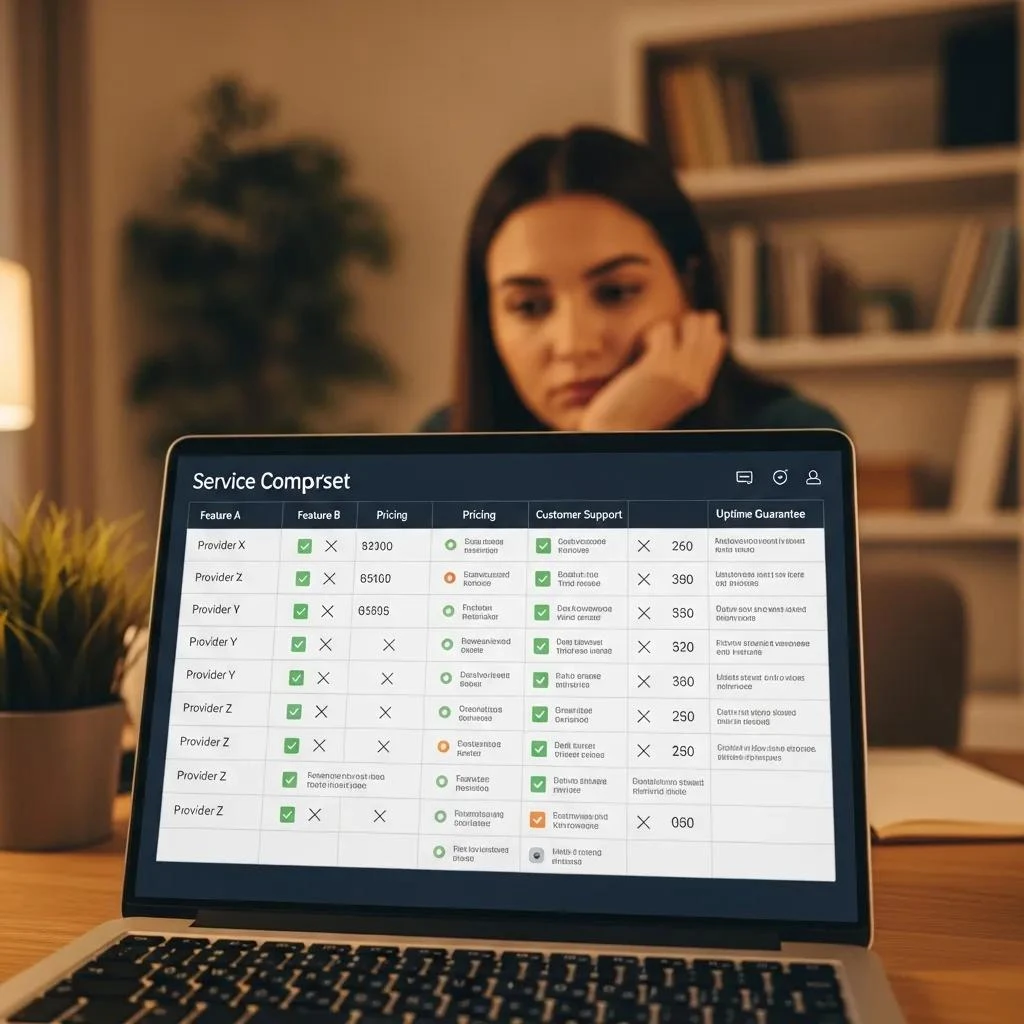
Use a simple comparison scorecard
For each provider, record a clear answer to these questions. Mark unanswered points for follow-up rather than assuming they are included.
- Are our essential website functions covered?
- Are backup frequency, retention, and recovery responsibilities documented?
- Are support hours and escalation steps clear?
- Do we understand which fixes cost extra?
- Will we receive evidence of completed work and outstanding issues?
- Do we retain appropriate ownership and account access?
- Is there a clear process for leaving or changing providers?
Weight the answers by your needs. A business dependent on online orders may place more value on tested recovery and urgent support than on an allowance for minor content edits.
Check experience and handover practices
Ask about experience with your platform and the kinds of integrations you use. References can help you understand communication and reliability, but the proposal should still describe your own service terms.
Confirm how access is granted and removed, who manages licenses, and what documentation is provided. A professional handover should make it clear how another provider could take over without confusion about ownership.
Compare total cost and responsibilities
Review the monthly fee alongside onboarding, hosting, licenses, emergency work, and tasks outside the scope. Check minimum terms and cancellation arrangements before committing.
A lower fee may be suitable for a simple site, but it is not automatically better value. Compare the responsibility being taken on and the support your business actually needs.
Ask your website maintenance provider about the first month
A clear onboarding plan shows how a website maintenance provider will turn the proposal into regular work. First, ask which information the team needs from you and who will coordinate the transition. Next, confirm how the provider will review existing problems and establish the site’s starting condition.
For example, a form that already fails should appear in the initial issue list. Otherwise, both sides may assume the other team knows about it. Share known problems, recent changes, and the visitor tasks that matter most to your business. Also, identify any upcoming promotions or busy periods that affect timing.
Agree on the first review and handover record
Set a date to review the first report together. Ask the provider to explain what they checked, what they completed, and what still needs a decision. Then, compare that report with the agreed scope. This gives you a practical opportunity to resolve misunderstandings early.
Keep an account inventory that identifies each service and the person responsible for it. The inventory should explain ownership and support contacts without placing passwords in a shared report. Use the appropriate secure process when the provider needs access.
Finally, discuss how the same records would support a future handover. A useful service relationship should leave your business with clear documentation and a current list of outstanding work. This makes it easier to manage routine care, review service quality, and plan changes as your website grows.
Frequently asked questions
Is hosting the same as maintenance?
No. Hosting provides the environment where your site runs. Maintenance may include software updates, functional checks, monitoring, and support. Confirm where the responsibilities overlap.
Should the provider guarantee that nothing will break?
No website can be guaranteed free of every issue. Look for prevention, detection, recovery preparation, and clear communication.
Can maintenance replace a redesign?
Routine care can keep a site functioning, but larger structural or user-experience problems may need a separate project.
Choose a provider with a clear plan
Review MWD’s website maintenance services and discuss the requirements of your site. For an explanation of the underlying tasks, read what monthly maintenance should include. Use the same criteria to compare proposals and resolve any gaps before choosing a plan.
About the author
Patrick Mabarak writes about web design, website development, and digital marketing at MWD Web Design, Inc. Learn more at patrickmabarak.com.
