
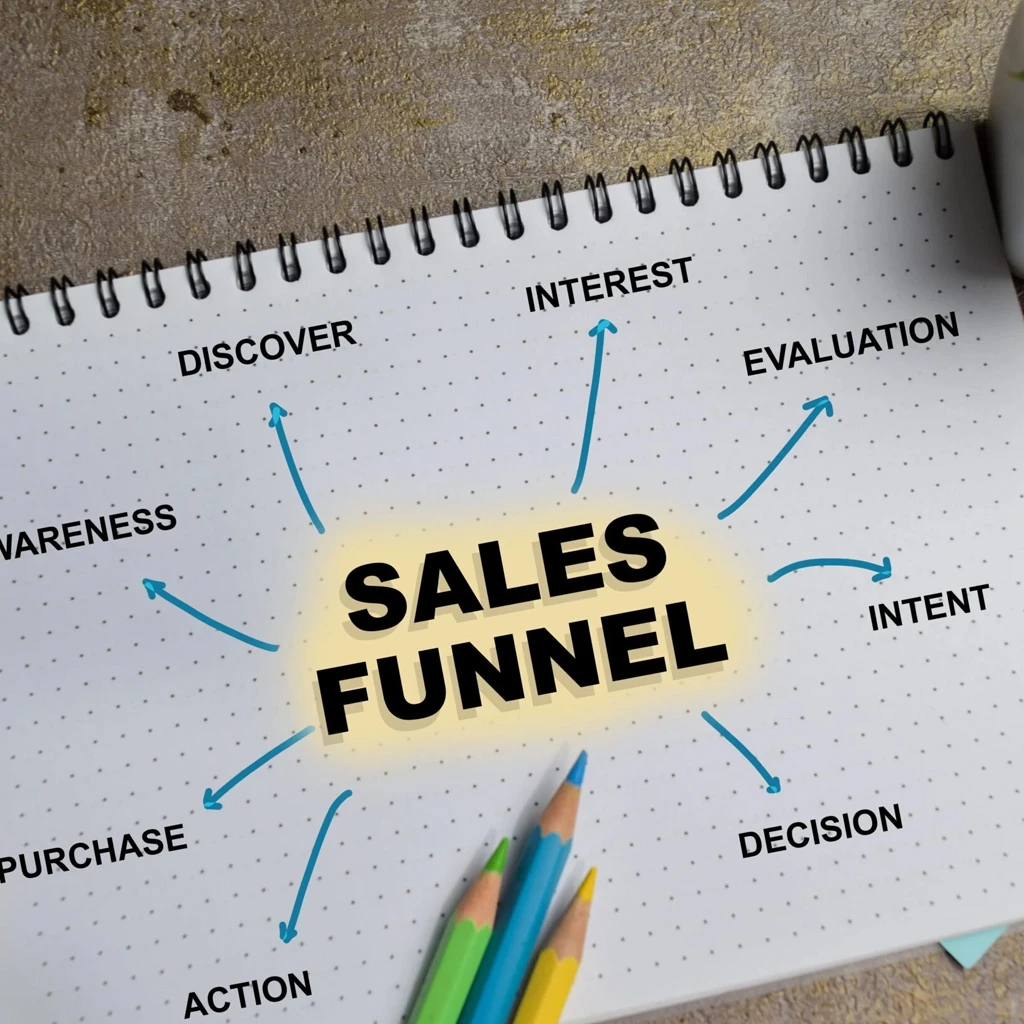
Most business websites have the same quiet problem: they get visitors, but those visitors don’t turn into customers. People land on a page, poke around for a minute or two, and leave — never to return. Sound familiar?
This is exactly what a website sales funnel is designed to fix.
A website sales funnel is a strategic, step-by-step path that guides your visitors from their very first click all the way to becoming a paying customer — and ideally, a repeat buyer who sends referrals your way. It’s not a single page or a single tactic. It’s a system built into your website that works around the clock, even while you’re sleeping.
At MWD Web Design, we’ve spent over two decades building conversion-focused websites for Florida businesses and growth-minded companies nationwide. In that time, we’ve seen one pattern repeat itself over and over: businesses that invest in a well-designed website sales funnel consistently outperform those that don’t — regardless of how much they’re spending on ads or SEO.
This guide breaks down exactly what a website sales funnel is, how it works, what makes one succeed (or fail), and how you can build one that genuinely converts.
What Is a Website Sales Funnel?
A website sales funnel is a structured online marketing process that moves a potential customer through several stages — from first discovering your business to making a purchase or inquiry.
The term ‘funnel’ reflects a simple reality: you’ll always have more people enter the top than exit the bottom as buyers. But the goal is to make that funnel as efficient as possible — attracting the right people, keeping them engaged, and removing every obstacle between interest and action.
A well-built website sales funnel typically includes:
- Awareness — People find you through search, social media, paid ads, or word of mouth
- Interest — They land on your website and find content or messaging that resonates
- Consideration — They explore your services, read reviews, or compare you to competitors
- Decision — They’re ready to act and you make it easy for them to do so
- Retention — You follow up, nurture the relationship, and earn repeat business
Each stage requires different content, messaging, and design decisions. Skipping a stage — or doing one poorly — is where most websites lose sales.
Why Most Websites Don’t Function as Sales Funnels
Here’s something that might be uncomfortable to hear: having a website is not the same as having a website sales funnel.
A typical business website is built to look good and share information. A sales funnel website is built to move people toward a specific action. The difference is enormous.
Here’s where most websites fall flat:
- No clear call-to-action (CTA): Visitors don’t know what to do next. They read a page and… nothing guides them forward.
- Weak or missing lead capture: There’s no offer, no form, no reason for someone to give you their email address.
- No follow-up system: Even if someone shows interest, there’s no automated sequence to nurture them.
- Confusing navigation: Too many choices overwhelm visitors and lead to decision paralysis.
- No trust signals: No reviews, no credentials, no case studies — nothing to overcome skepticism.
- Slow load times: Research consistently shows that even a one-second delay in page load time can reduce conversions by 7%.
If any of these sound like your website, you’re leaving real money on the table.
The 5 Core Stages of a Website Sales Funnel

1. Top of Funnel (TOFU): Attract the Right Traffic
The funnel starts before someone even hits your website. You need to be visible where your ideal customers are looking.
Strategies that work at this stage:
- SEO and content marketing: Blog posts, guides, and landing pages that rank for keywords your customers are actively searching
- Paid advertising: Google Ads and Meta Ads that put your offer directly in front of your target audience
- Social media: Organic and paid social that builds awareness and drives clicks
- Referral and word of mouth: Happy customers and strategic partnerships that send qualified leads your way
The key at this stage is relevance. You want traffic that’s actually interested in what you offer — not just eyeballs.
2. Middle of Funnel (MOFU): Build Trust and Engagement
Once someone lands on your website, your job is to keep them there and give them a reason to come back.
This is where great design, compelling copy, and smart content strategy make all the difference.
What works at the middle-of-funnel stage:
- A strong homepage or landing page that immediately communicates who you help, what you do, and why you’re the right choice
Social proof: Client testimonials, Google reviews, case studies, and before/after results - Educational content: Blog posts, FAQs, videos, and explainers that answer your prospects’ top questions
- Lead magnets: Free resources (checklists, guides, consultations) offered in exchange for an email address
- Clear navigation that makes it easy to find what someone is looking for without overwhelm
Think of the middle of your funnel as the trust-building phase. Nobody buys from a stranger — your website’s job is to make you feel familiar, credible, and worth their time.
3. Bottom of Funnel (BOFU): Convert Visitors Into Customers
This is where the magic happens — or doesn’t. The bottom of the funnel is all about conversion.
At this stage, your visitor has done their research and they’re weighing their options. Your job is to make saying yes as easy as possible.
Key conversion elements:
- Compelling service or product pages that clearly articulate the value of what you offer
- Strong, specific CTAs: Not just ‘Contact Us’ — but ‘Get Your Free Website Audit’ or ‘Schedule a 30-Minute Strategy Call’
- Pricing transparency (or a clear next step if exact pricing isn’t possible)
- Risk reducers: Money-back guarantees, free trials, no-obligation consultations
- Simple, fast contact forms: Every extra field you add reduces your conversion rate
- Live chat or chatbot: For visitors who want answers right now
Real-world example: One of our clients, a service-based business in the Tampa Bay area, saw a 43% increase in quote requests within 60 days of redesigning their service pages with clearer CTAs and adding a single-step contact form. The traffic didn’t change — the funnel did.
4. Post-Conversion: Retain and Delight
Closing the sale isn’t the end of the funnel — it’s the beginning of a longer relationship.
Customers who feel valued after their purchase are far more likely to:
- Buy from you again
- Leave you a positive review
- Refer friends, family, and colleagues
- Upgrade to higher-tier services
Post-conversion strategies to build into your website funnel:
- Thank-you pages that offer a next step (a related resource, an upsell, or a request for a review)
- Email nurture sequences that deliver value and keep your brand top of mind
- Client portals or dashboards that make working with you easy and professional
- Follow-up surveys to gather feedback and show you care
5. Re-Engagement: Bring Back Lost Leads
Not everyone will convert on the first visit. In fact, most won’t. That’s why re-engagement is an essential part of any website sales funnel.
Tactics for winning back visitors who didn’t convert:
- Retargeting ads: Show targeted ads to people who visited your site but didn’t take action
- Email re-engagement campaigns: Reach out to cold leads with a new offer or updated content
- Remarketing landing pages: Create pages specifically designed for return visitors who are further along in their research
What Makes a Website Sales Funnel Actually Work?
Building a funnel is one thing. Building one that consistently converts is another. Here’s what separates high-performing funnels from ones that just look nice.
- Clarity over cleverness. The best-performing funnels are simple. Visitors should immediately understand what you do, who you help, and what to do next. If they have to think too hard, they’ll leave.
- Mobile-first design. More than 60% of web traffic now comes from mobile devices. If your funnel isn’t optimized for smartphones, you’re losing a majority of your potential customers before they even read a word of your copy.
- Speed matters more than you think. A slow website kills conversions. Pages should load in under 3 seconds. This isn’t a nice-to-have — it’s a baseline requirement.
- Consistent messaging from ad to landing page. If someone clicks an ad about ‘affordable website design in Florida’ and lands on a generic homepage, they’ll bounce. Message match — keeping your messaging consistent from the first touchpoint to the last — is one of the highest-leverage improvements you can make.
- Data-driven optimization. The best funnels are never ‘done.’ They’re continuously improved using real data: heatmaps, A/B tests, conversion tracking, and user session recordings.
How to Audit Your Existing Website Sales Funnel
Not sure where your funnel is breaking down? Here’s a quick audit framework:
- Check your traffic sources. Where are visitors coming from? Are they the right people?
- Review your bounce rate. A high bounce rate on key pages signals a disconnect between expectation and reality.
- Map your CTAs. Does every key page have a clear, relevant next step?
- Test your forms. Are they working? Are they too long? Do they load on mobile?
- Review your thank-you pages. Are they a dead end, or do they move the relationship forward?
- Look at your email follow-up. Are you following up with leads who didn’t convert? How quickly? How often?
- Check your page speed. Use Google PageSpeed Insights to identify slow pages.
- Read your copy out loud. Does it sound like a real person talking to another real person? Or does it sound like a brochure?
Website Sales Funnel Tools Worth Knowing
You don’t need a massive tech stack to build an effective funnel. Here are the categories of tools that matter:
- Website platform: WordPress (with a solid page builder) or a custom-built site gives you the flexibility to build a true funnel
- CRM: Tools like HubSpot, GoHighLevel, or even a simple CRM to track and manage leads
- Email marketing: ActiveCampaign, Mailchimp, or Klaviyo for automated follow-up sequences
- Analytics: Google Analytics 4 for traffic and behavior data; Hotjar or Microsoft Clarity for heatmaps
- A/B testing: Google Optimize or built-in tools within your CMS
- Live chat: Intercom, Drift, or a simple chatbot to catch visitors who are ready to talk now
The right tools depend on your business model, budget, and technical resources — but the goal is always the same: remove friction and keep the conversation going.
Frequently Asked Questions About Website Sales Funnels
What is a website sales funnel?
A website sales funnel is a strategic online system that guides potential customers through a series of steps — from first discovering your business to making a purchase or inquiry. Unlike a basic website, a sales funnel is intentionally designed to move visitors toward a specific action at every stage.
How is a sales funnel different from a regular website?
A regular website provides information. A sales funnel website is engineered to convert. Every page, CTA, and piece of content in a funnel serves a deliberate purpose — to guide the visitor one step closer to becoming a customer.
How long does it take to build a website sales funnel?
A basic funnel — landing page, lead capture, and automated follow-up — can be built in two to four weeks. A comprehensive funnel with full content strategy, custom pages, CRM integration, and A/B testing typically takes one to three months. The timeline depends on the complexity of your offerings and the tools you’re working with.
Do I need a big budget to build a sales funnel?
Not necessarily. Many small businesses build effective funnels with a solid website, a simple CRM, and a basic email marketing tool. The most important investment is strategic thinking — understanding your customer journey and designing each touchpoint intentionally. That said, working with an experienced web design agency will significantly accelerate your results.
What’s the most important part of a website sales funnel?
This is debated, but most experienced marketers would say it’s the landing page and the offer. If you can’t get someone to take the first step — whether that’s signing up, clicking, or calling — nothing else matters. A compelling, relevant offer paired with a clean, fast landing page is the foundation of any successful funnel.
How do I know if my website sales funnel is working?
Track these key metrics: conversion rate (visitors who take your desired action), cost per lead, lead-to-customer rate, and revenue attributed to website-generated leads. If conversions are low, audit each stage of your funnel to find where visitors are dropping off.
Can a website sales funnel work for service businesses?
Absolutely. In fact, service businesses often benefit more from a well-designed funnel than product-based businesses. A funnel helps a service business qualify leads before they reach the sales team, build trust through content and social proof, and automate follow-up — all of which save time and improve close rates.
What is the biggest mistake businesses make with their website sales funnel?
Asking for too much too soon. Sending cold traffic directly to a ‘Buy Now’ or ‘Request a Quote’ page without first building awareness and trust almost always results in poor conversion rates. A well-designed funnel warms up the visitor before making a significant ask.
Your Website Should Be Working for You
 A website that doesn’t convert is just an expensive brochure.
Building a real website sales funnel means thinking beyond design and into strategy — understanding who your customer is, where they are in their decision-making process, and what they need to feel confident saying yes.
At MWD Web Design, Inc., this is exactly what we do for businesses across Florida and beyond. We build conversion-focused websites and marketing systems designed to attract the right visitors, build genuine trust, and turn clicks into customers.
Whether you’re starting from scratch or looking to optimize an existing site, we’d love to take a look at what’s working and what’s not.
Ready to turn your website into your best salesperson?
Contact the MWD Web Design team for a free website consultation and let’s talk about what a real website sales funnel could do for your business.
About the Author
Patrick Mabarak is a seasoned digital marketing strategist and web design expert with over a decade of experience helping businesses enhance their online presence. Patrick specializes in integrating SEO best practices with user centered design to create websites that perform well in both search rankings and user engagement.
Learn more at patrickmabarak.com
